
From iNaturalist to National Geographic
When people talk about iNaturalist, they often focus on its extraordinary scientific value. Every observation contributes to one of the world's largest biodiversity databases, helping researchers document species distributions, monitor invasive species, detect rare wildlife, and understand how nature is changing. That alone makes it one of the most important conservation tools ever created, and one that BAND is incredibly proud to support.
Behind those millions of observations are countless untold stories: stories of discovery, a deeper understanding of the natural world, and people connecting through a shared fascination with biodiversity. BAND’s support for iNaturalist is intended to help tell more of these stories, inspiring curiosity, strengthening people’s connection with the natural world, and helping build a broader constituency for nature.
One of my own favorite untold iNaturalist stories happens to involve me, a member of the BAND team, and is a wonderful example of how a single observation can lead somewhere entirely unexpected: to a scientific paper, a friendship, and, rather remarkably, National Geographic.
It all began with a single iNaturalist observation.
Several years ago, while browsing iNaturalist records of Martial Eagles from Kenya's Maasai Mara, I came across a photograph that immediately piqued my interest.
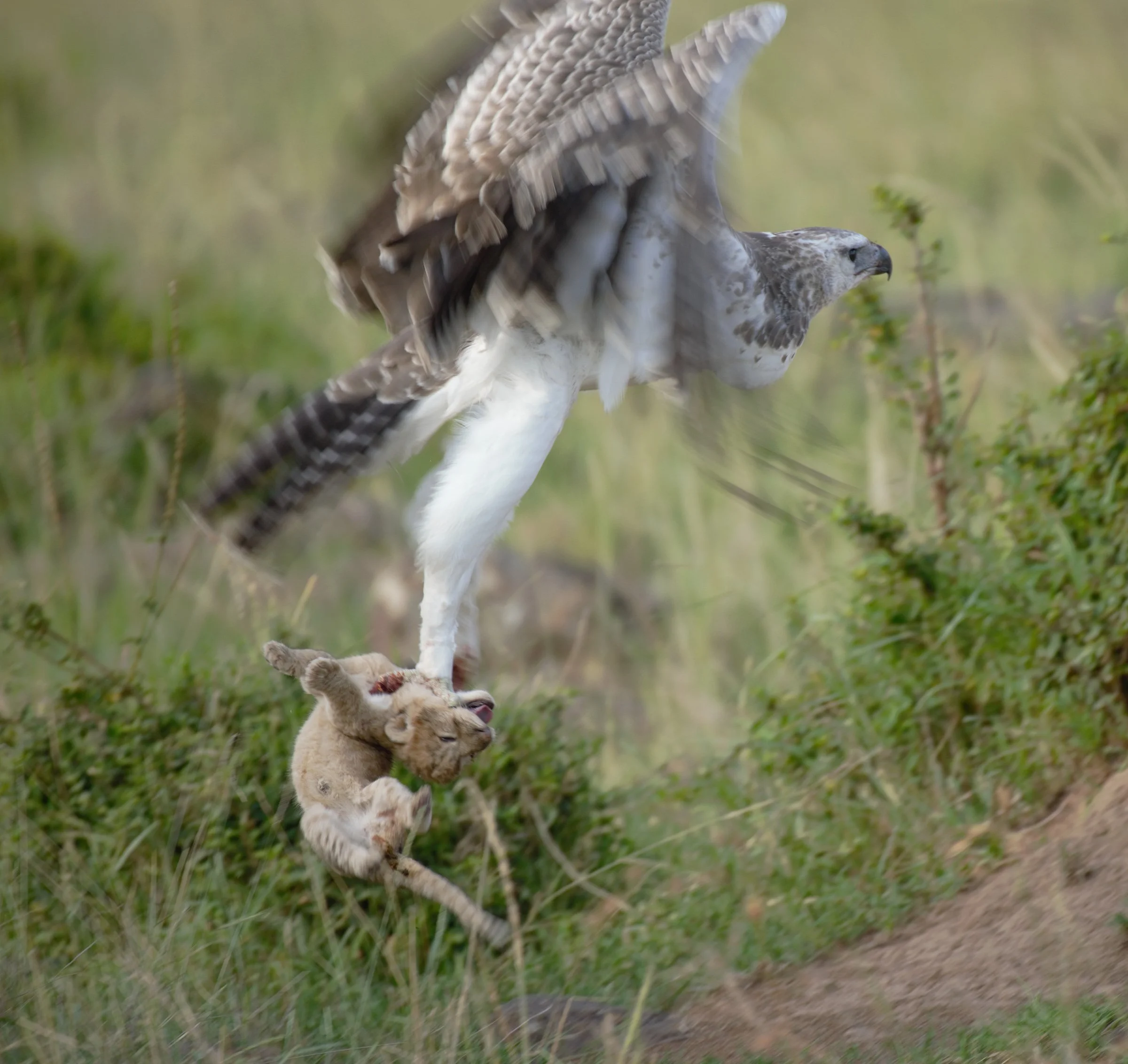
A juvenile Martial Eagle taking off with a lion cub in its talons. Photo Credit: Jes Lefcourt
At first glance I could hardly believe what I was seeing.
The observation had been uploaded by serial iNaturalist user Jes Lefcourt. Intrigued by such an extraordinary event, I reached out through iNaturalist. Jes was incredibly generous with both his time and his photographs. He explained the circumstances surrounding the observation and gave us permission to include his images in our research on Martial Eagle foraging ecology.
Those images became one of the cornerstones of a paper we later published documenting predation of lion cubs by Martial Eagles in the Maasai Mara. The study helped demonstrate that Africa's largest eagle is capable of preying upon one of Africa's most iconic carnivores, adding another fascinating layer to the remarkably complex interactions that occur among top predators. If you're interested in reading the paper, it is open access and freely available here.
At the time, I knew Jes simply as the photographer who had captured one of the most remarkable wildlife images I had ever seen.
Only later did I discover that he was the Director of EarthRanger, a conservation technology platform that helps protected area managers and researchers around the world integrate real-time ecological data into conservation decision-making. It has become one of the most influential platforms supporting biodiversity conservation globally.
As my own work increasingly began using EarthRanger, Jes and I found our paths crossing regularly at conferences and conservation meetings. Meeting him in person felt less like meeting the Director of EarthRanger and more like catching up with an old friend. We had connected through a shared passion for biodiversity and conservation, and what had begun with a single iNaturalist observation had quietly grown into a genuine friendship and professional relationship.
During one of those meetings, Jes joked that one day he hoped one of his photographs might be featured by National Geographic. I laughed and told him that, if I ever had the chance, I'd do my best to help make that happen.
Neither of us expected that opportunity to arrive so quickly.
Following the publication of our paper, the study attracted the attention of National Geographic, and a journalist contacted me to write a story about the discovery for their online platform. The article reached an enormous international audience, while the accompanying social media posts featured Jes's original photograph of the Martial Eagle carrying the lion cub.
It was a wonderful full-circle moment.
An observation shared freely with the iNaturalist community had found its way to one of the world's most influential conservation media platforms, reaching thousands of people around the globe. As a wonderful bonus, it also fulfilled one of Jes's dreams of having one of his photographs featured by National Geographic.
Perhaps most importantly, the story introduced countless people to a side of Martial Eagles that few knew existed. It challenged assumptions about predator hierarchies, illustrated just how complex food webs can be at the top of African ecosystems, and helped raise the profile of a remarkable raptor whose conservation often receives far less attention than many of the species it lives alongside.
None of that would have happened without someone deciding to upload a photograph.
That, to me, captures something special about iNaturalist.
Yes, it is an extraordinary biodiversity database. Every observation becomes part of a global record that researchers, conservationists, and land managers rely upon every day.
But it is also a community.
It is a place where curiosity is shared, where experts and newcomers meet on equal footing, where a photograph can inspire scientific discovery, where an online conversation can grow into a friendship, and where people separated by continents find common ground through a shared fascination with the natural world.
In an increasingly busy and disconnected world, communities built around genuine curiosity are incredibly valuable. iNaturalist reminds us that conservation is not only about protecting biodiversity, but also about connecting the people who care enough to notice it.
So, download the app, create an account, and start exploring. There is an extraordinary world of biodiversity waiting to be discovered, often much closer than we realize. Every observation has the potential to become part of a story, and you never know where that story might lead. It could satisfy your own curiosity, add a new species to your personal list, contribute to science, spark a friendship, inspire someone to care about nature, or even end up in National Geographic.
Stratton Hatfield